Visa Product Design System
2021, 2023-2025
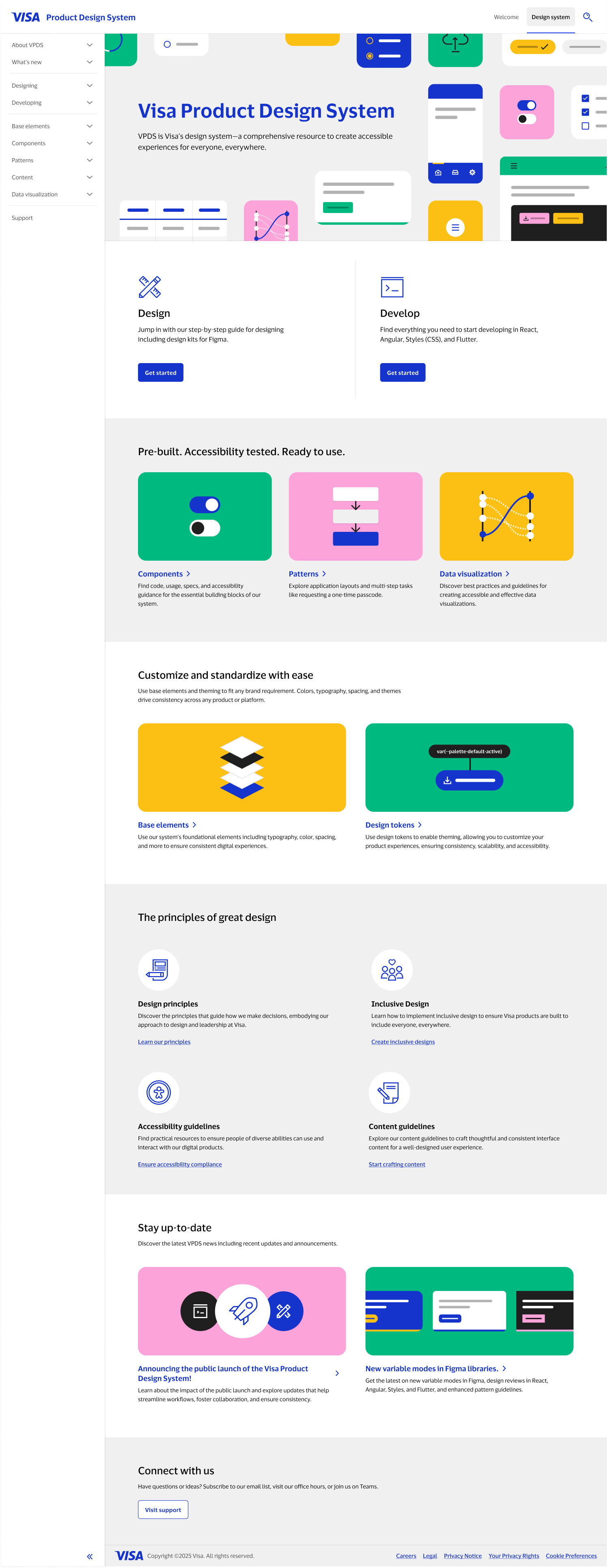
I began my Visa career working on the Visa Product Design System (VPDS), where I supported the system’s evolution from an internal Word doc to the fully public, multi-framework design system it is today. I partnered with designers, engineers, accessibility experts, and content strategists to grow VPDS into a scalable, consistent, widely adopted platform used across Visa’s global product ecosystem.
My contributions to Visa’s Design System span several years, beginning when I was just an intern. The following sections tell its story in reverse, beginning with our public launch and ending with its early stages as an internal word document.
Impact
Design systems typically deliver a 30%+ efficiency lift for the teams who adopt them. In the case of VPDS, from 2023 to 2025, web component usage increased 14x, with mobile usage showing similar growth. Adoption continues to rise as more teams use the system for net-new product work and redesigns.
Collaborators
Design: Alicia Frausto, Kristen Bonnett, Murphy Basore, Tracy Nguyen
Content Design: Allison Biesboer, Brandee Dudenhoefer, Chine Okeke
The final state: Public launch
In April 2025, VPDS officially became a public design system—an initiative that required a massive cross-functional effort and marked a milestone for Visa’s design organization.
In collaboration with two other content designers, my contributions included:
End-to-end content strategy including content auditing, SEO strategy, landscape analysis, and net-new onboarding pathways.
Internal communications + quarterly release narratives to guide teams through the transition from an internal system to a public-facing one.
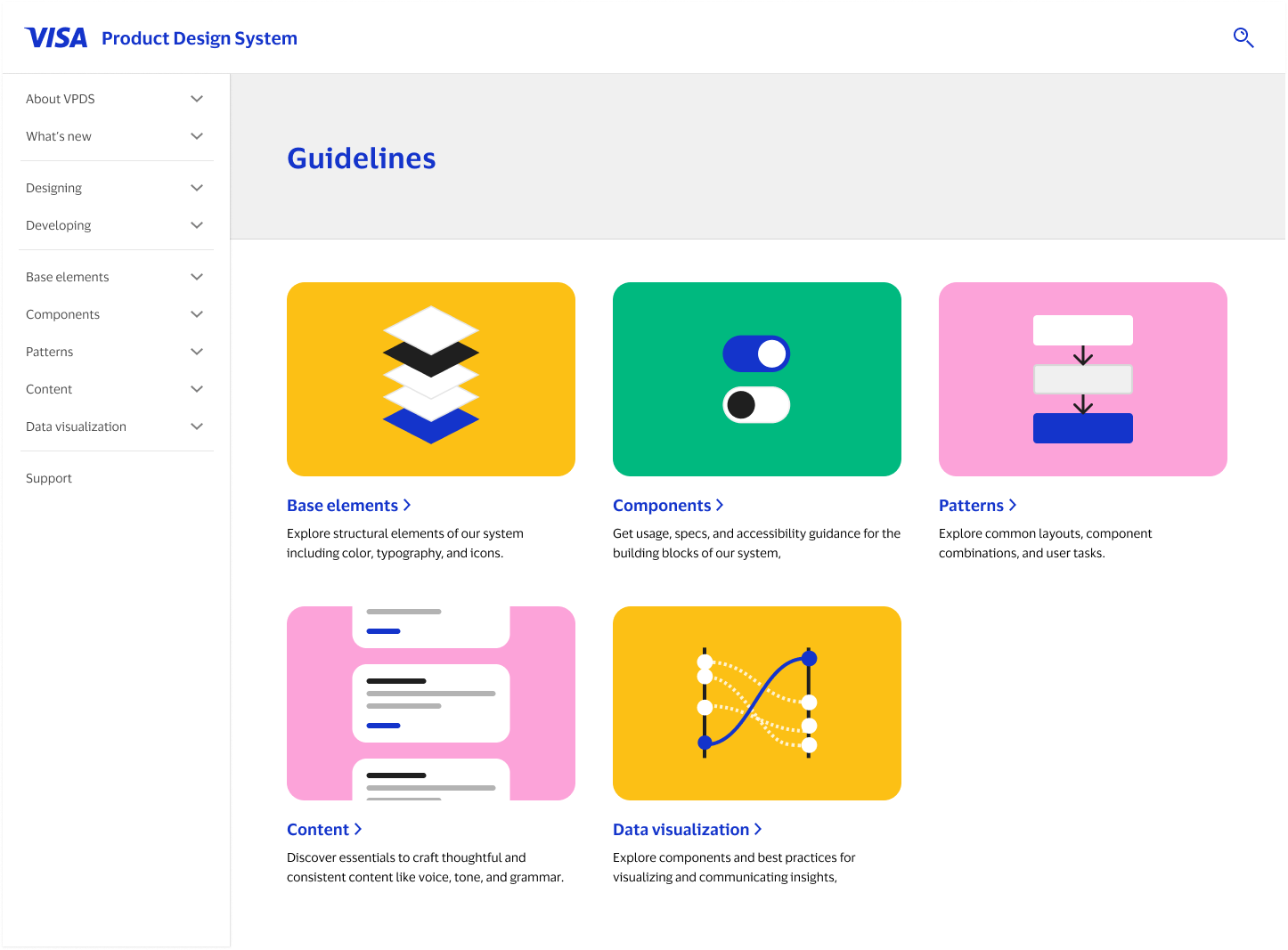
Significant IA restructuring informed by internal research, competitive analysis, and interviews with design, engineering, and accessibility partners.
Legal, brand, and accessibility alignment, ensuring every piece of content met Visa’s compliance standards.
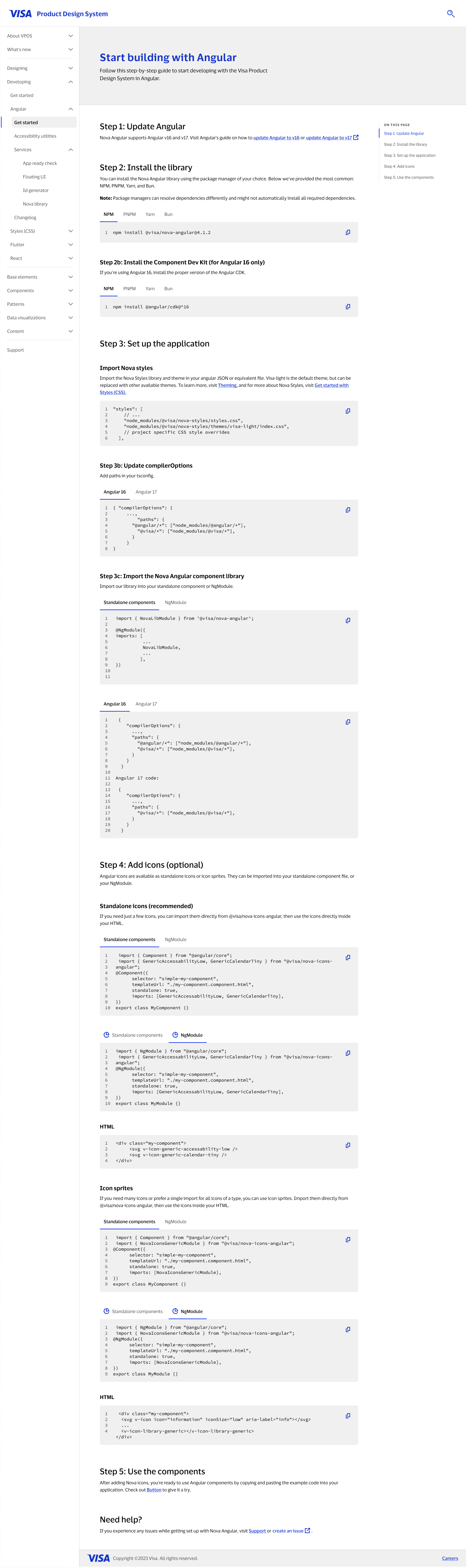
New “Getting Started” experiences for four supported development frameworks (React, Angular, CSS, and Flutter), created through deep collaboration with engineering partners to ensure consistency, clarity, and a beginner-friendly experience.
This phase brought VPDS into its most mature, scalable state and laid the foundation for continued product-wide adoption.


The middle: System expansion
Before launching VPDS as a public design system, our efforts focused on maturing the system, particularly by turning a large set of disparate Figma files into a fully functional website. Under the mentorship of a staff-level content designer, my contributions included:
Performing discovery, iteration, and testing on rounds of information architecture adjustments to establish an easy-to-navigate experience.
Co-developing the Component Guidelines Content Model, a repeatable structure that brought consistency across the system and made it easier to scale documentation as new components were introduced.
Expanding core guidelines across design, content, accessibility, and developer documentation.
Supporting in the research, planning, design, and end-to-end creation for new components including Wizard, File Upload, Pagination, and Dynamic Table.
Building full parity across all four tech libraries, ensuring each framework had clear, cohesive implementation guidance.
Leading governance efforts to enforce naming conventions, pattern consistency, and content quality across system contributors.
The beginning: Word doc to Design System
My journey with VPDS started as a college intern, working on what was, at the time, the very first version of our Product Content Style Guidelines, which lived entirely in a Word document.
My work involved analyzing competitor systems to outline and define Visa’s style guidance, including Voice and tone, Inclusive language, Readability, and more. When I returned the following year as a full-time employee, I helped shepherd that document into usable guidance by:
Performing significant information architecture work to transform the document into a collection of Figma pages to streamline access.
Adapting educational content into actionable, workflow-oriented guidance.